Documentation
BioComp is a web tool for estimating biomass composition using ultimate and chemical analysis data. Calculations are based on the biomass characterization method discussed in the Debiagi, Ranzi, et al. papers (see References section). Also, see the documentation for the Chemics biocomp function for implementation details of the characterization procedure.
The BioComp source code is available on GitHub. Submit a Pull Request if you would like to contribute to the project. Questions and other comments can be submitted on the GitHub Issues page. You can also contact the developer of BioComp, Gavin Wiggins, via Email or Mastodon.
Quick start
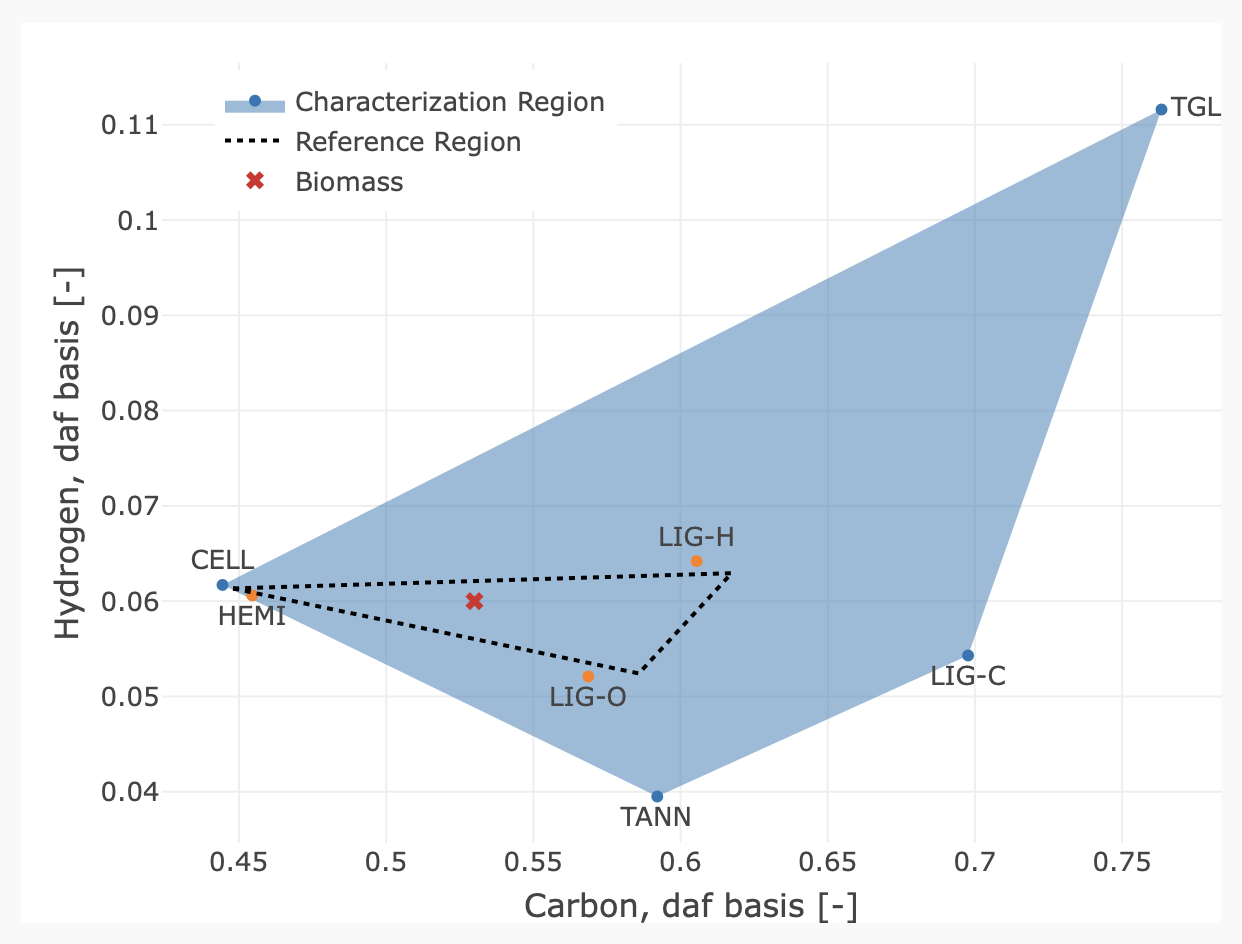
Just click the Submit button to view results for the default input parameters. The results are displayed in a table that represents the biomass composition. A graph is also displayed that compares the biomass to the reference mixtures. Read the sections below to learn more.
Parameters
There are several methods for providing input parameters to BioComp which are listed below. The first method requires the least number of inputs while the last method requires the most input. For best results, use method 3 to provide as many input parameters as possible.
- The easiest way to use BioComp is to just input the carbon (C) and hydrogen (H) mass fractions of the biomass feedstock. Make the water and ash inputs zero and leave the remaining inputs as their default values.
- Another method is to provide all the ultimate analysis parameters of the biomass feedstock including the water and ash content. This will provide the estimated biomass composition results for the wet and wet-ash bases. Leave the remaining input parameters as their default values.
- If chemical analysis data is available for the biomass feedstock, then input the values for cellulose, hemicellulose, and total lignin along with the ultimate analysis values. Select the optimize splitting parameters checkbox to use the chemical analysis values to improve the splitting parameters. This will ensure that the Y (daf) results align with the chemical analysis values of the biomass feedstock.
The splitting parameters should generally remain at their default values. If the estimated biomass composition contains negative values, then adjust the splitting parameters until the biomass is within the reference region on the graph.
Ultimate analysis
The ultimate analysis parameters represent the utlimate analysis values of the biomass feedstock that will be characterized by BioComp. The values must be given as mass percent on a dry ash-free basis (C and H) or as received basis (H₂O and Ash). The carbon and hydrogen values are required. The water and ash values are used for converting the results to wet and wet-ash bases. If you are not interested in the results for the wet basis or wet-ash basis then just input zero for these values.
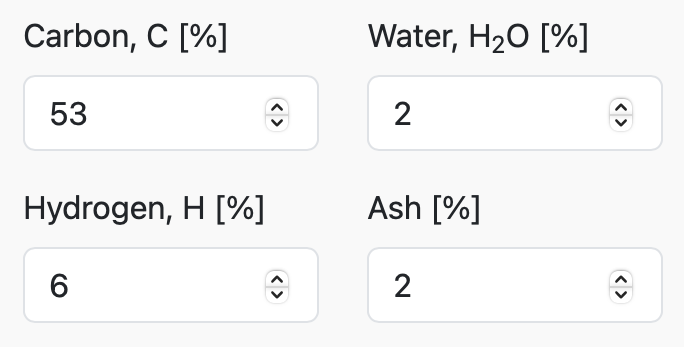
- Carbon - mass percent of carbon (C), dry ash-free basis
- Hydrogen - mass percent of hydrogen (H), dry ash-free basis
- H₂O - mass percent of water, as received basis
- Ash - mass percent of ash, as received basis
Chemical analysis
The chemical analysis parameters represent the chemical composition of the biomass feedstock as cellulose, hemicellulose, and total lignin. The values must be given as mass percent on a dry ash-free basis. The optimize checkbox must be selected to use the chemical analysis values for the characterization procedure; otherwise, the values are ignored. This will adjust the splitting parameters so the Y (daf) results match the given cellulose, hemicellulose, and total lignin values.
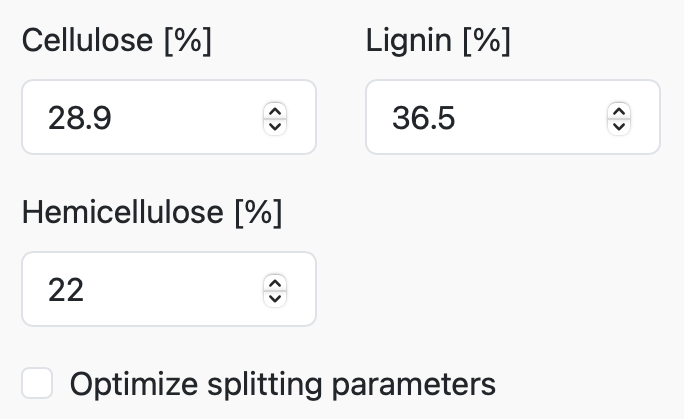
- Cellulose - mass percent of cellulose (CELL), dry ash-free basis
- Hemicellulose - mass percent of hemicellulose (HEMI), dry ash-free basis
- Lignin - mass percent of total lignin, dry ash-free basis
Splitting parameters
The splitting parameters define molar ratios of the chemical components used in the biomass characterization procedure. Use the default values unless the biomass marker in the graph is outside the reference mixture region.
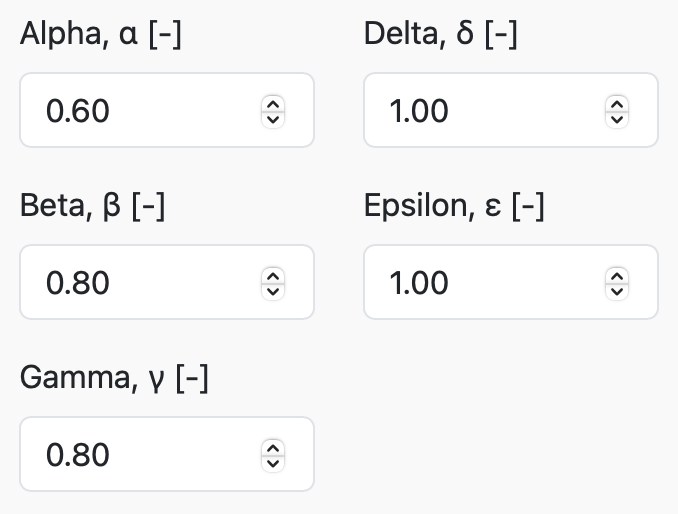
- α - molar ratio of cellulose and hemicellulose
- β - molar ratio of lignin LIG-O and lignin LIG-C
- γ - molar ratio of lignin LIG-H and lignin LIG-C
- δ - molar ratio of lignins (LIG-H and LIG-C) and extractive TGL
- ε - molar ratio of lignins (LIG-O and LIG-C) and extractive TANN
Results
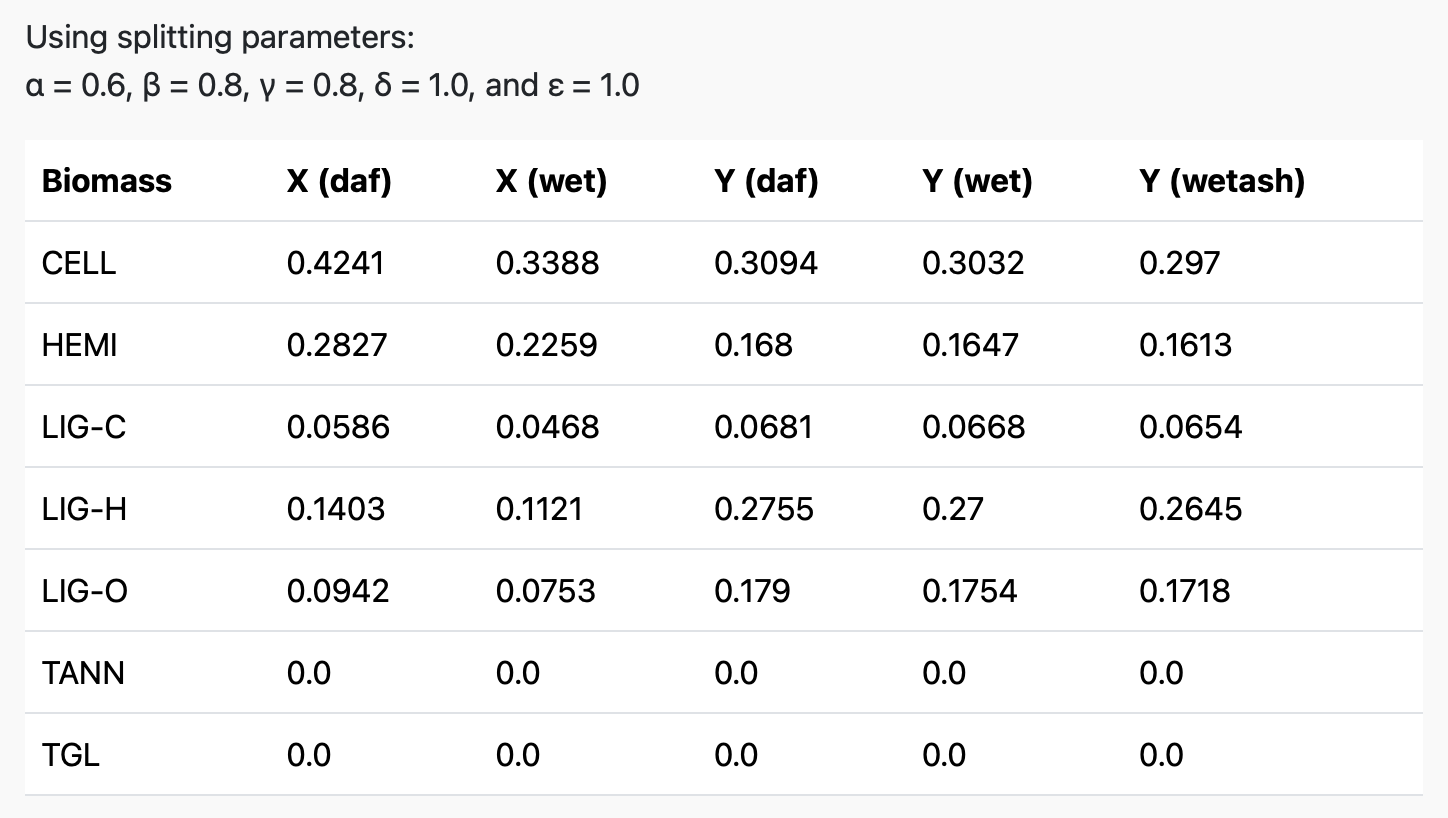
Submit the parameters to view results in the biomass composition table and characterization graph. The rows in the table represent the biomass composition as cellulose (CELL), hemicellulose (HEMI), carbon-rich lignin (LIG-C), hydrogen-rich lignin (LIG-H), oxygen-rich lignin (LIG-O), tannin (TANN), and triglycerides (TGL). The table provides results as mole fractions (X) and mass fractions (Y) where daf is the dry ash-free basis, wet is the wet basis, and wetash is the wet-ash basis. The values of the splitting parameters used for the characterization are displayed above the table. When the chemical analysis parameters are used, the splitting parameter values displayed above the table are the values determined from the optimization procedure.
The characterization graph displays the biomass C/H ratio as a red cross marker. The marker compares the biomass to the reference mixtures which are represented by the corners of the Reference Region. If the biomass marker is outside the Reference Region, then the splitting parameters need to be adjusted until the marker is within the Reference Region.
References
The references for estimating biomass composition are given below.
- Paulo Debiagi, Chiara Pecchi, Giancarlo Gentile, Alessio Frassoldati, Alberto Cuoci, Tiziano Faravelli, and Eliseo Ranzi. Extractives Extend the Applicability of Multistep Kinetic Scheme of Biomass Pyrolysis. Energy & Fuels, vol. 29, no. 10, pp. 6544-6555, 2015.
- Paulo Debiagi, Giancarlo Gentile, Alberto Cuoci, Alessio Frassoldati, Eliseo Ranzi, Tiziano Faravelli. A predictive model of biochar formation and characterization. Journal of Analytical and Applied Pyrolysis, vol. 134, pp. 326-335, 2018.